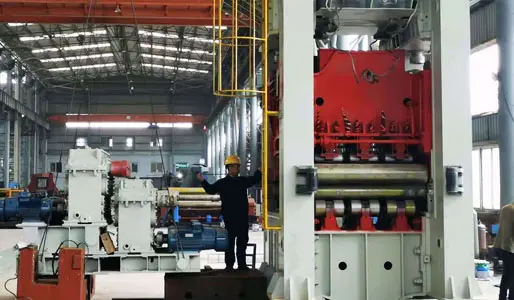
Introduction: A press frame is the closed structural loop that carries forming force, and understanding it explains why two machines with similar force ratings can behave differently in production.
When a heavy hydraulic press closes on a blank, the force does not disappear into the floor. It travels in a loop: from the ram into the tooling, through the workpiece, into the bed, up through the uprights, across the crown, and back into the ram. That loop is the frame, and every part of it stretches a little under load. How much it stretches, and in which direction, decides whether the die halves stay lined up and whether the formed part comes out the same way on the thousandth stroke as it did on the first. this guide follows the load from the tooling into the structure, then explains what rigidity and deflection actually change in the forming process.
Load enters the structure through contact. The ram pushes the upper tool, the upper tool pushes the workpiece, and the workpiece pushes back against the lower tool and the bolster plate. From there the force spreads into the bed, which is the heavy table the lower die sits on, and the bed passes it outward into the uprights. The uprights carry it up to the crown, the top structure that houses the main cylinder or drive, and the crown feeds it back into the ram. In a well-designed press this is a closed loop, and the frame's job is to complete that loop without letting the tooling drift out of position. Floor anchoring is part of the same story: a frame that can shift or rock on its foundation turns a forming problem into a moving-target problem. What matters for understanding the process is not just the size of the loop but where the load actually sits inside it. A centred load travels symmetrically down the bed and up both uprights, so each side carries a similar share. An off-centre load does something different. One upright takes more, the bed bends unevenly, and the ram can tilt slightly as the tooling meets resistance. This is why a bed that is generous in size but lightly built behaves differently from a compact, heavily built one: the same force travels a longer, more flexible route and produces more visible movement where the dies meet. Following the path shows that load carrying is a routing question as much as a strength question.
Rigidity is the frame's resistance to elastic change under load. It is not the same thing as strength. A strong frame survives a heavy stroke; a rigid frame barely changes shape while that stroke happens. Both matter, but only rigidity shapes the geometry of the forming operation itself. Every press frame deflects to some degree, because steel behaves like a spring: it stores the load by stretching and returns when the load is released. The useful question is how much deflection occurs, where it appears, and whether it disturbs the relationship between the punch and the die.
Tool alignment is a geometric relationship, and it is easy to disturb. If the crown bows upward and the bed sags under load, the gap between the punch and the die changes across the working area, even though nothing has visibly moved. Small angular changes become meaningful over long distances: a fraction of a millimetre of tilt across a wide bed translates into a changed clearance at the die edge, and die clearance is one of the things that decides whether a part is cut cleanly, drawn evenly, or stretched where it should not be. A structure that resists this movement keeps the punch travelling where the die expects it, stroke after stroke, which is what consistency in forming really means on a production floor.
When the frame flexes, the force distribution across the tooling changes with it. Metal forming relies on controlled plastic deformation: the material yields where the stress exceeds its flow strength and flows into the die cavity, as described in materials-processing teaching from MIT OpenCourseWare. That flow is sensitive to pressure distribution. If the bed deflects in the middle, pressure concentrates toward the centre of the workpiece and eases at the edges, so a blank that should be pressed evenly is worked unevenly. Thicker or harder sections then take load first and pull force away from neighbouring areas. The visible result can be uneven thinning, uneven springback, and parts that measure differently depending on where they sat in the press.
"Rigid frame" is a description, not a measurement. A press machine factory will often highlight a robust structure because it genuinely matters, but the same word can cover very different behaviours depending on how the structure closes, how the load is introduced, how sections are proportioned, and how the machine is anchored. Two presses rated for the same force can follow different load paths, and the one with the shorter, more symmetrical path usually gives the tooling an easier life. General engineering standards, such as the ASME codes and standards collection, exist precisely because structural behaviour needs defined criteria rather than adjectives, and heavy industrial equipment guidance from the DOE Technical Standards Program follows the same logic for installation and technical documentation. For readers comparing machines, this is the practical takeaway: structure tells you what a press can hold steady, and tonnage tells you how hard it can push. They answer different questions. Published information on EZHONG's hydraulic press machine confirms its metal forming role along with factory engineering, technical support, and project quotations, while frame material, welding process, and structural parameters are settled at the project stage rather than published as fixed catalogue values. That is why structural questions are best asked as specific questions about load path, bed support, and alignment under load, not as a single yes-or-no about whether a frame is strong.
Frame rigidity and load path are what turn a force rating into a forming process. Force enters through the tooling, spreads into the bed, climbs the uprights, crosses the crown, and returns to the ram, and the frame's resistance to elastic movement decides how well the dies stay aligned along that route. Deflection does not simply bend metal; it redistributes pressure across the die and the workpiece, which shows up as variation in clearance, thinning, and springback. Understanding this relationship makes press behaviour readable, whether the machine sits in a workshop or on a drawing board, and it gives structural questions a clear purpose when evaluating a real forming project.
A: Load enters at the tooling. The ram presses the upper die, the workpiece transfers force to the lower die and bolster plate, and the bed spreads it outward into the uprights. The uprights carry it up to the crown, and the crown returns it to the ram, closing a structural loop. Floor anchoring completes the path by keeping the whole loop stable.
A: Rigidity controls how little the frame changes shape while force is applied. When the crown and bed resist movement, the punch stays aligned with the die and pressure stays evenly distributed across the workpiece. When they flex, die clearance and pressure distribution shift, so parts can vary in thickness, springback, and edge quality from stroke to stroke.
A: No single structural property guarantees quality. A rigid frame helps hold tooling alignment and even force distribution, but results also depend on tooling condition, material behaviour, process settings, and how the workpiece sits in the die. Frame rigidity is one enabling condition among several, and its value shows up most clearly when heavy loads and tight tolerances meet.
List of ASME Codes & Standards - ASME
DOE Technical Standards Program
Lecture Notes - Materials Processing - MIT OpenCourseWare
EZHONG Hydraulic Press Machine Listing