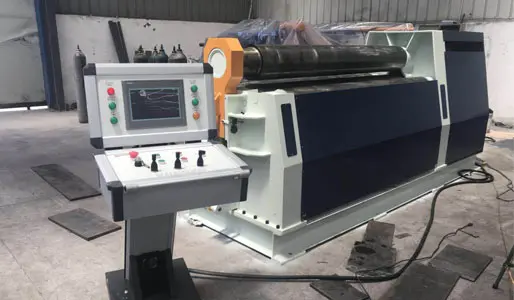
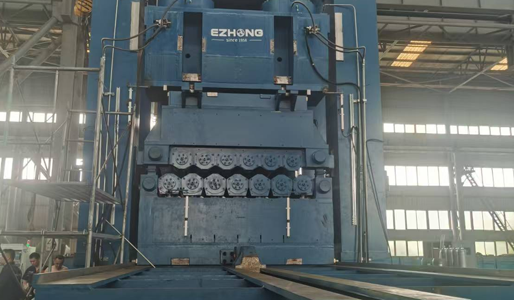
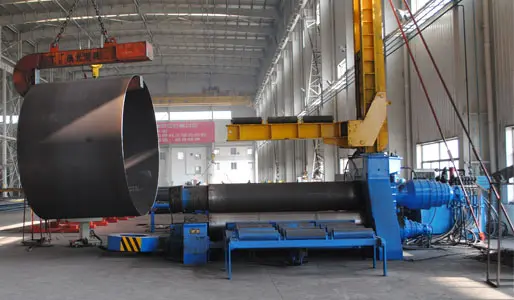
Steel plate rolling is a cornerstone manufacturing process in heavy industry. From massive wind tower sections and pressure vessels to ship hulls and offshore structures, the ability to transform flat steel plates into precise curved forms is essential to modern industrial fabrication.
Unlike light sheet bending, steel plate rolling deals with thick materials, large diameters, and high-strength steel grades. These demands place far greater requirements on rolling machines, process control, and operator experience. A small deviation in curvature or roundness can result in assembly difficulties, welding defects, or structural risk.
This comprehensive guide explains what steel plate rolling is, how the process works, the types of plate rolling machines used, and how heavy-duty rolling supports critical industries worldwide. Whether you are an engineer, fabricator, or equipment buyer, this page provides a clear technical foundation for understanding plate rolling at an industrial scale.
Steel plate rolling is a metal forming process that bends flat steel plates into curved geometries by passing them through a series of rollers under controlled force. The plate undergoes plastic deformation, allowing it to retain a cylindrical, conical, or arc shape after leaving the machine.
The process is widely used because it:
Maintains material continuity
Preserves structural strength
Enables large-radius forming
Reduces welding and joints
Typical products formed by plate rolling include:
Cylindrical shells and pipes
Conical reducers and transitions
Tank bodies and pressure vessel shells
Curved structural components
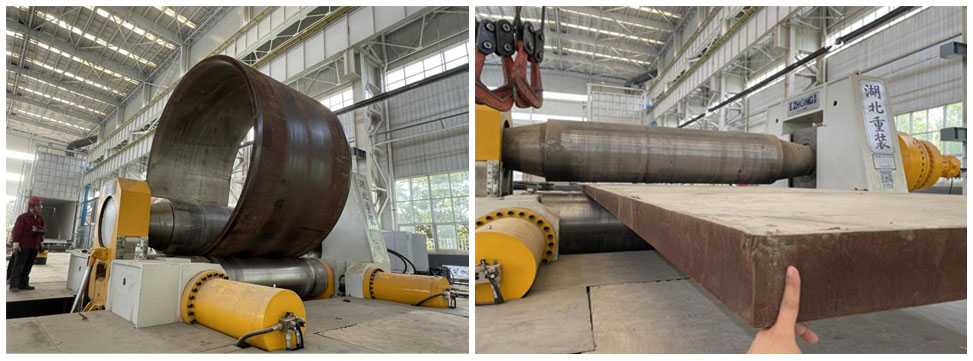
Steel plate rolling has been used since the early industrial era, but modern rolling technology—especially hydraulic and CNC-controlled machines—has dramatically improved accuracy, efficiency, and repeatability, particularly for heavy-duty applications.
At the heart of steel plate rolling is controlled plastic deformation. When a steel plate is pressed between rollers, stress is applied gradually across its thickness:
The outer surface of the plate stretches
The inner surface compresses
The neutral axis shifts depending on material properties
By adjusting roll position, pressure, and feed speed, the plate is bent incrementally until the desired radius is achieved.
Most industrial plate rolling machines use either:
Three-roll configurations, or
Four-roll configurations
Each setup applies force differently, influencing accuracy, efficiency, and material handling.
Although machine designs and automation levels vary, the rolling workflow follows a structured sequence.
Before rolling begins, the steel plate must be properly prepared:
Surface cleaned of rust, oil, and scale
Edges trimmed and deburred
Dimensions verified against drawings
For pressure vessels or critical structures, material certificates and traceability are often required.
Correct setup is essential, especially for thick plates. This includes:
Adjusting roll gaps according to plate thickness
Setting initial roll pressure
Aligning the plate parallel to the rolls
Incorrect setup can lead to uneven curvature, edge distortion, or excessive springback.
Pre-bending forms the leading and trailing edges of the plate before full rolling. Without pre-bending, flat ends remain after rolling, causing gaps during welding.
Pre-bending:
Improves roundness
Eliminates flat zones
Enhances seam alignment
Further reading: Pre-Bending in Heavy-Duty Plate Rolling: Why It Matters
During the rolling stage, the plate passes repeatedly through the rollers. With each pass:
Curvature increases gradually
Stress is evenly distributed
Deformation becomes more uniform
For thick or high-strength plates, incremental rolling is used—multiple passes with increasing pressure.
After reaching the target radius, fine adjustments are made:
Reverse rolling for roundness correction
Symmetrical pressure application
Dimensional inspection
This stage is critical for components requiring tight tolerances.
Steel plate rolling can be performed either at room temperature or with pre-heating.
| Aspect | Cold Plate Rolling | Hot Plate Rolling |
| Temperature | Ambient | Elevated |
| Required force | Higher | Lower |
| Precision | Higher | Moderate |
| Surface finish | Better | Oxide scale present |
| Typical use | Thin–medium plates | Thick & high-strength plates |
Cold rolling is preferred where dimensional accuracy and surface quality matter.
Hot rolling is commonly used for very thick plates, large diameters, or steels with high yield strength.
Choosing the correct plate rolling machine is critical for productivity and quality. Machine structure determines forming capability, precision, and ease of operation.
The 3 roller plate rolling machines are widely used in general fabrication.
Characteristics:
One top roll, two bottom rolls
Lower investment cost
Suitable for medium thickness plates
Requires plate flipping for full pre-bending
Limitations:
Lower automation
More manual handling
Less efficient for thick plates
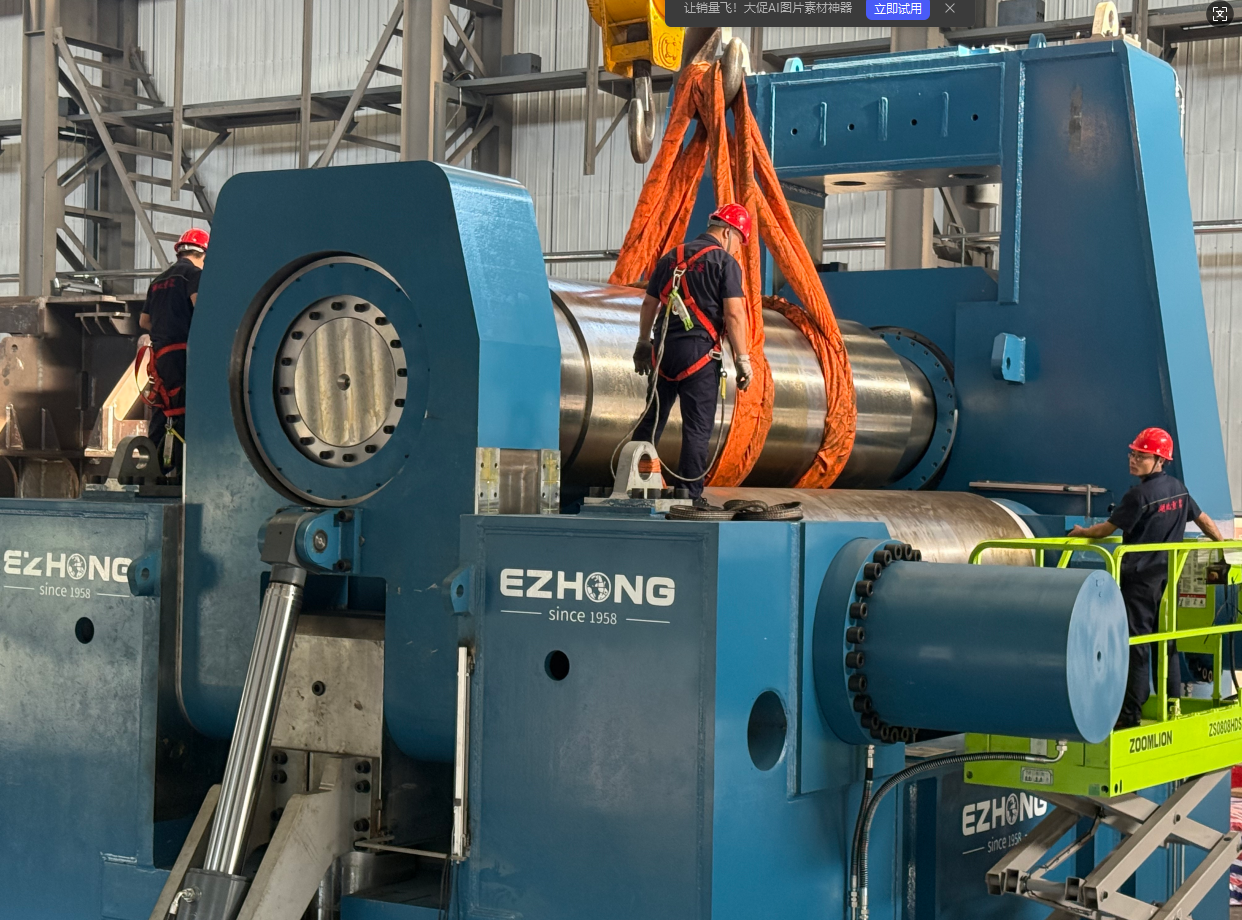
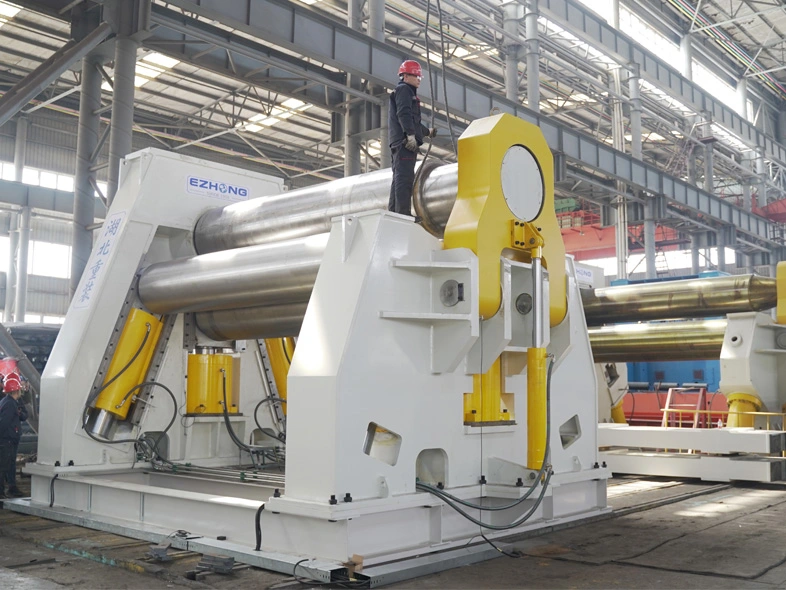
The 4 roller plate rolling machine is the preferred solution for heavy-duty and precision rolling.
Key advantages:
Pre-bending both ends in one setup
No plate flipping required
Higher rolling accuracy
Better control of thick and wide plates
Higher productivity
This makes 4-roll machines ideal for:
Wind tower sections
Pressure vessels
Large storage tanks
Offshore structures
Further reading: 3-Roll vs 4-Roll Plate Rolling Machines: What's the Difference?
Modern heavy-duty plate rolling machines are typically:
Fully hydraulic
CNC-controlled
Benefits include:
Programmable rolling sequences
Automatic springback compensation
Repeatable results across batches
Enhanced safety and efficiency
Heavy-duty rolling machines are designed to handle a wide range of materials:
Carbon steel (A36, Q235, S235)
Structural steel (A572, S355)
Pressure vessel steel (SA516, P265GH)
Stainless steel
Alloy steel
Material properties such as yield strength, thickness, and ductility directly affect:
Required rolling force
Machine size
Rolling strategy
Rolling thick plates is not simply “applying more force.” It requires technique.
Accurate pre-bending minimizes flat ends and stress concentration.
Multiple passes with gradually increasing pressure improve accuracy and reduce cracking risk.
Over-bending is used to counter elastic recovery after unloading.
Steel plate rolling supports nearly every heavy industry.
Rolled shells form wind turbine towers and foundations.
Pressure vessels, reactors, and storage tanks rely on precise rolling.
Hull sections and offshore platforms require large-diameter rolling.
Cranes, mining machinery, and industrial equipment use rolled structures.
Bridges, silos, and architectural steel often require custom curvature.
Application | Key Rolling Requirement |
Wind towers | Large diameter, thick plates |
Pressure vessels | High roundness accuracy |
Storage tanks | Consistent curvature |
Ship hulls | High-strength steel |
Industrial silos | Long shell lengths |
When selecting a plate rolling machine supplier, buyers should evaluate more than specifications.
Key factors include:
Maximum thickness and width capability
Minimum achievable diameter
Machine frame rigidity
Hydraulic system reliability
CNC control quality
After-sales service and support
A manufacturer with deep industry experience can recommend not just a machine, but a complete rolling solution.
Steel plate rolling is a critical forming process that combines mechanical power, material science, and process expertise. For heavy-duty applications, success depends on machine rigidity, precise control, and an in-depth understanding of material behavior.
As a professional manufacturer of heavy-duty plate rolling machines, EZHONG focuses on delivering robust, reliable, and high-precision solutions for demanding industrial applications worldwide.
Heavy-duty machines can roll plates exceeding 100 mm, depending on material strength and machine design.
Yes. With adjustable roll positioning, modern machines can roll cones and variable-radius shapes.
Flat ends result from insufficient pre-bending. Proper pre-bending eliminates this issue.
For thick plates and precision applications, CNC control greatly improves consistency and efficiency.