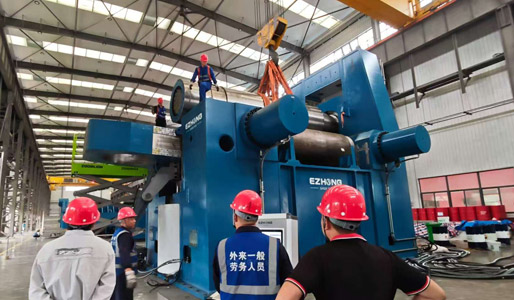
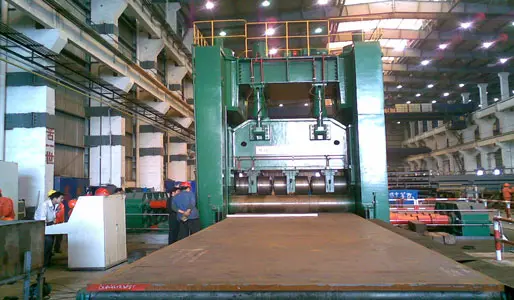
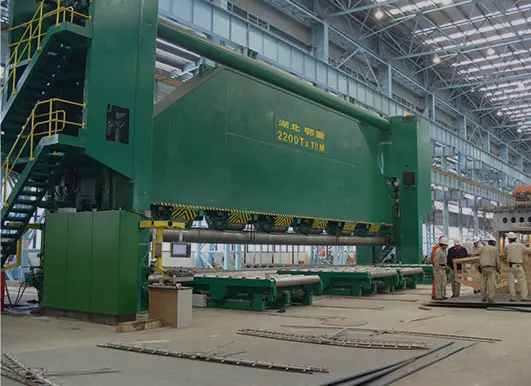
Picture the massive pressure vessels powering refineries, the towering wind-turbine towers slicing through offshore winds, or the thick-walled cylindrical sections that form the hulls of ice-class ships. These aren't shaped by magic—they're born from heavy-duty plate rolling machines applying thousands of tons of force to multi-inch-thick steel, stainless, or high-alloy plates. Yet one seemingly small detail often determines whether the final cylinder meets code, passes hydro-testing on the first try, or requires costly rework: pre-bending.
In heavy-duty applications—where plates routinely exceed 1 inch thick and can reach 6 inches or more—pre-bending isn't just a nice-to-have step. It's a make-or-break requirement for achieving structural integrity, minimizing material waste, and controlling production costs. Without effective pre-bending, even the most powerful plate roll can leave unacceptable flat spots at the plate ends, leading to misalignment during welding, stress concentrations, and potential failures under pressure or cyclic loading.
This in-depth guide explores what pre-bending really is in the context of heavy plate rolling, why it's especially critical for thick materials, how the process differs between common plate rolling machine types, and the tangible benefits (and risks of skipping it) that shop managers and engineers face every day.
Pre-bending (also called pre-pinching or edge bending) is the deliberate initial curving of the leading and trailing edges of a flat plate before the main rolling operation begins. The goal is to form those edges to match the intended final radius so that, once the full cylinder is rolled, the two ends meet with near-perfect alignment and minimal—or zero—unbent straight sections.
In any plate rolling process, the geometry of the rolls creates a natural limitation: there's always a short distance where the plate isn't fully engaged by the bending forces. This results in the infamous "flat end" or "unbent flat" that can measure 1.5 to 3 times the plate thickness (or more on heavy plates without proper technique).
Pre-bending attacks this problem at the source by using the machine's rolls (or sometimes a separate press brake) to impart curvature to the edges first. On modern heavy-duty machines, this happens either as dedicated edge passes or—ideally—as an integrated part of a single-pass rolling sequence.
The result? A rolled cylinder whose longitudinal seam is ready for welding with almost no post-rolling trimming, grinding, or shimming required.
Heavy plates (typically 1–6+ inches thick) behave differently than thin sheet. They exhibit far greater springback, higher resistance to deformation, and much more stored energy. A flat spot on a 4-inch-thick pressure-vessel shell isn't just cosmetic—it can create:
Weld imperfections — Misaligned edges force welders to add filler metal unevenly, risking inclusions, lack of fusion, or distortion.
Stress risers — Sharp transitions from curved to flat concentrate hoop and longitudinal stresses, increasing fatigue risk in cyclic-service vessels.
Code compliance issues — ASME Section VIII, EN 13445, and similar standards often require full circumferential curvature with minimal flat edges for pressure-retaining components.
Material inefficiency — Flat ends frequently force fabricators to start with oversized plates, then trim away expensive alloy after rolling.
Pre-bending directly addresses these challenges, turning a potential headache into a predictable, repeatable outcome.
The way pre-bending is achieved—and how effectively it eliminates flat ends—varies dramatically depending on whether you're running a 3-roll or 4-roll heavy-duty plate roller.
Traditional 3-roll designs (pyramid, initial-pinch, or variable-geometry) rely on two fixed bottom rolls and one adjustable top roll. The top roll can't contact the extreme edges during main rolling, so pre-bending requires separate, deliberate steps:
Load the plate and position one edge under the top roll.
Lower the top roll and/or adjust the bottom rolls to create the initial edge bend.
Roll forward slightly to form the pre-bend.
Reverse the plate (manually or via swing-arm), and repeat for the opposite edge.
Proceed to full rolling.
This process demands experienced operators who can "feel" the right pressure and position to minimize residual flat. Even skilled hands typically leave 1.5–2.5× thickness flat spots on heavy plate unless multiple corrective passes are made.
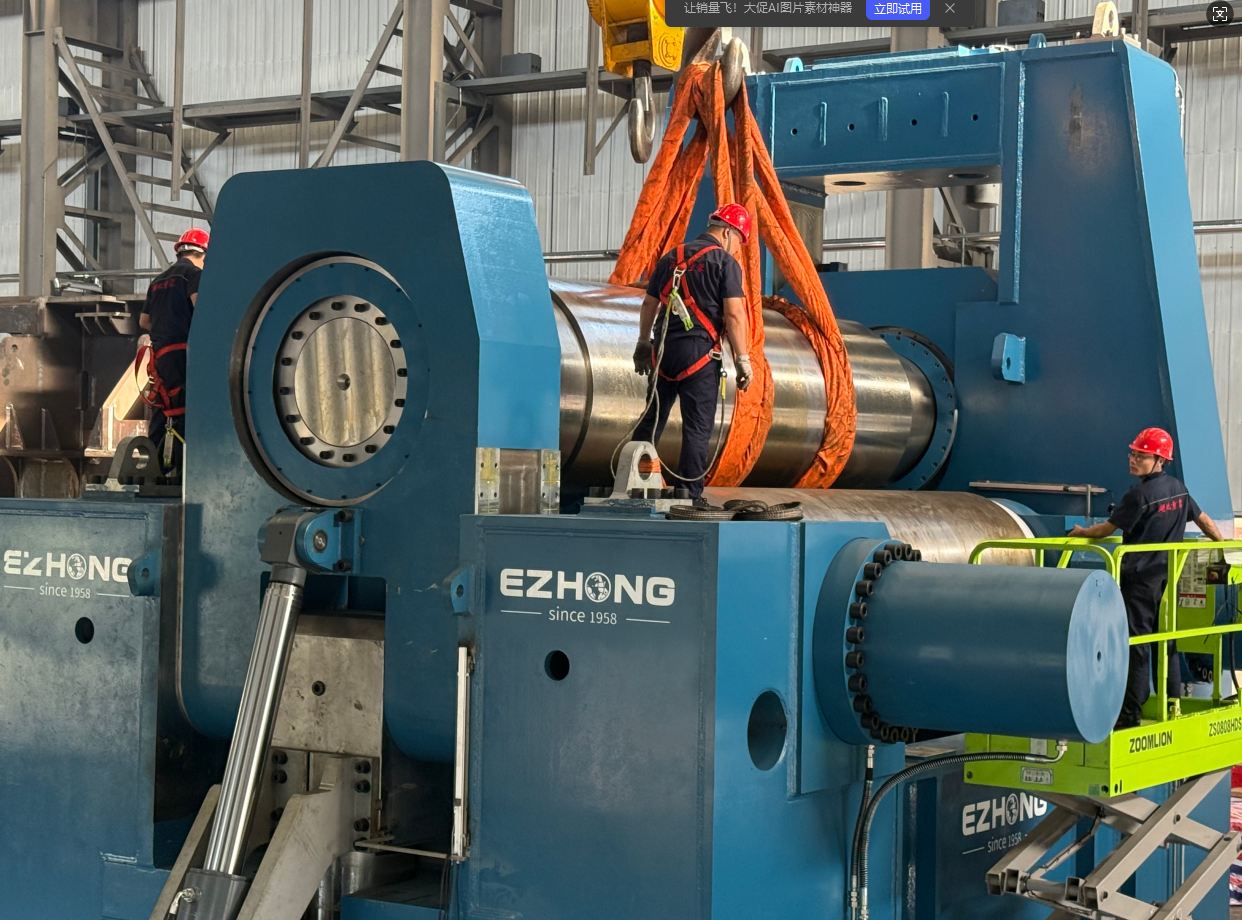
The addition of a fourth roll—usually a fixed or pinching bottom roll—changes everything. The plate is pinched between the top and bottom rolls from the start, providing constant clamping. The two independent side rolls then move in coordinated sequence:
Pinch the plate securely.
Raise one side roll to pre-bend the leading edge while the plate is held.
Roll the body while maintaining pinch.
Reverse direction or adjust to pre-bend the trailing edge—all without releasing the plate.
Many CNC-controlled 4 roller plate rolling machines perform this in one continuous pass, producing cylinders with virtually no flat ends—even on 4–6 inch thick plate. The enclosed "pinch" action also reduces slippage, improves safety, and allows tighter radii on thick materials.
Near-Zero Flat Ends — Eliminates or drastically reduces unbent sections, ensuring full-radius curvature for better weld prep and stress distribution.
Material Savings — No need to oversize plates to compensate for trimming; pre-bent edges meet precisely, cutting scrap by 5–15% on expensive heavy alloys.
Time and Labor Efficiency — Single-pass 4-roll pre-bending can shave 40–70% off cycle times compared to multi-step 3-roll sequences, critical when you're rolling dozens of thick cans per shift.
Improved Weld Quality and Structural Integrity — Perfect edge alignment reduces weld defects, distortion, and post-weld heat treatment needs—vital for ASME-stamped vessels.
Repeatability and Reduced Operator Dependence — CNC 4-roll systems store pre-bend parameters, delivering consistent results even with less-experienced crews.
Pre-bending becomes indispensable in:
Pressure-vessel and boiler fabrication (ASME VIII requirements)
Wind-tower and monopile sections
Offshore and shipbuilding components
Thick-wall storage tanks and silos for oil & gas
Nuclear and defense-grade cylinders
For very large-diameter, low-pressure structural pipes where flat ends can be trimmed or welded over without issue, some fabricators skip aggressive pre-bending on 3-roll plate rolling machine to save time—but this is the exception, not the rule, in true heavy-duty work.
In heavy-duty plate rolling, the difference between a good part and a great one often comes down to how well the edges are pre-formed. Shops that prioritize machines with strong pre-bending performance—especially modern 4-roll CNC models—see lower scrap rates, faster throughput, fewer weld repairs, and happier inspectors.
If your shop handles thick plates for demanding applications, ask yourself: Are we fighting flat ends on every job? Could better pre-bending shave hours off production and thousands off material costs? The answer is usually yes—and the payback on upgrading to effective pre-bending technology can be surprisingly quick.
Whether you're evaluating a new heavy-duty roll or optimizing existing equipment, mastering pre-bending isn't optional—it's the foundation of high-quality, cost-effective heavy fabrication.