Introduction: Roll count and roll diameter do different jobs in heavy plate leveling, and treating them as one number is the most common mistake in equipment selection.
A plate buyer or process technician comparing leveling machines runs into a wall of numbers quickly: 7 rolls, 13 rolls, 17 rolls, plus a roll diameter that may be 200 mm on one machine and 360 mm on another. The instinct is to assume the larger pair of numbers wins. Roll count tells you how many times the plate is bent from one direction to the other. Roll diameter tells you how much thickness the machine can push through while keeping its gap geometry. Reading them as two separate ideas is what makes the 7-to-17 ladder understandable.
Every roll gap in a leveler bends the plate one way, and the next gap bends it back the other way. A 7-roll machine gives the plate roughly five working bends between entry and exit; a 17-roll machine gives roughly fifteen. Each of those bends drives the outer fibers past yield, so the original wave or coil set is progressively overwritten by smaller alternating curvatures. What the operator sees at the exit is the net result of the whole sequence, not the work of any single roll.
• Repeated bending events. More rolls means more curvature reversals, and more reversals means the top and bottom surfaces end up closer to the same strain. That is why a wavy plate can come out nearly flat after one pass on a 13-roll or 17-roll machine.
• Contact points. Every roll that touches the plate spreads the working load. On a longer stack, the first gaps take the heavy correction and the last gaps handle fine trimming, so no single roll carries the entire job alone.
• Entry stability. A plate arrives with visible waves and sometimes hard camber. A longer stack bends it a little at each gap instead of forcing one aggressive bend at the entry, which keeps the plate tracking straight as it goes in.
• Exit curvature control. The final two or three gaps decide the outgoing shape. A 17-roll machine has more room to work that exit shape, which matters when a tight flatness class must be met rather than simply improved.
The practical reading is that roll count measures how many chances the machine gets. It says nothing about whether the rolls themselves can handle the plate standing in front of them.
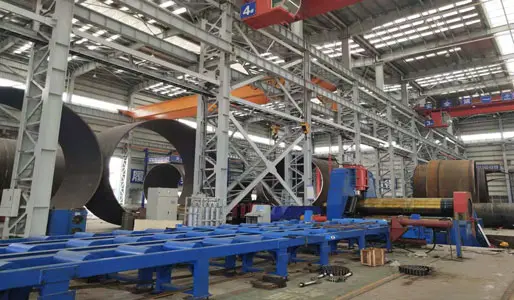
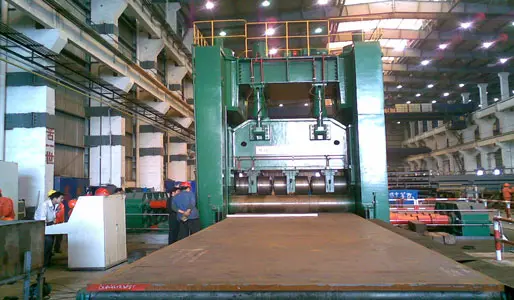
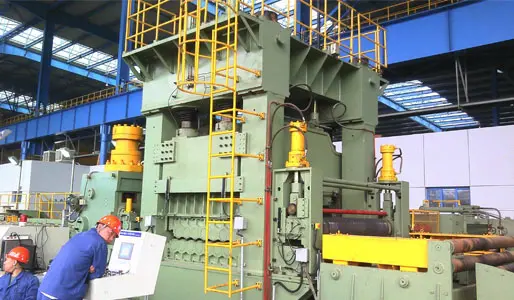
Roll diameter is where thickness capacity and structural stiffness live. A leveling roll has to push a plate past its yield point and then hold a straight axis while doing it. If the roll body and shaft are too slender for the plate, the roll deflects under load, the gap opens in the middle, and the plate leaves flat at the edges but still crowned or wavy through the center. A larger roll diameter buys bending stiffness directly, which is why thick plate levelers carry visibly heavier rolls than machines built around thin sheet. The difference shows up fast in a workshop. Feed a 6 mm plate through a machine with modest rolls and everything looks fine; feed a 40 mm plate through the same machine and the roll diameter and the housing behind it run out of answers. Adding roll count does not rescue that situation. A 17-roll machine built with small rolls is a precision tool for moderate thickness, not a heavy plate machine. In general terms, roll diameter has to grow with plate thickness. Engineers often frame it as a diameter-to-thickness relationship: the thicker the plate, the larger the roll needs to be for the same bending effect without excessive force and deflection. Larger rolls also mean a longer contact arc, more torque demand, and a heavier frame, so the machine gains weight and cost along with diameter. Diameter is a capacity decision, not a finish detail. The W43 family shows the logic in practice. EZHONG builds leveling machines across 7-, 9-, 11-, 13-, 15-, and 17-roll configurations under the W43T, W43B, W43C, and W43V series names, including a hot plate leveller for hot-rolled plate and variants aimed at high-strength steel. Complete thickness, width, and force limits are not published as one universal table, so the diameter and roll count on a quotation should be matched to the actual plate list rather than assumed from a series name.
Intermesh is the bridge between the two numbers. Intermesh is how far each upper roll is pressed below the plane of the lower rolls, and it sets how much curvature each gap imposes on the plate. Deep intermesh produces a strong bend, which thick and high-strength plate needs before it will yield at all. Deep intermesh also produces high separating force, and that force has to be carried by a roll body and a housing that hold their shape under it. Roll count without the diameter and frame stiffness to support deep intermesh does very little for a heavy plate. Roll spacing ties the two numbers together in a less obvious way. The pitch between rolls usually scales with roll diameter, because a bigger roll needs more room. A 9-roll machine built with large-diameter rolls can have a longer working length than a 13-roll machine built with smaller rolls. Comparing roll count across machines without checking diameter and spacing therefore tells you very little: the same 13-roll label can describe two quite different tools, one for general plate and one for heavy sections. Read as a ladder, the configurations step up in bending events. A 7-roll machine handles basic repeated bending for moderate waviness. Nine and 11 rolls add reversal events and a smoother entry. Thirteen and 15 rolls give finer exit control and better trim of the outgoing shape. Seventeen rolls give the most bending events and the tightest exit adjustment. Each rung only holds, though, when the roll diameter, intermesh range, and drive capacity are sized for the plate thickness and yield strength going through the gap. The flatness class you have to hit shapes the choice as well. EN 10029 sets dimensional and shape tolerances for hot-rolled steel plate, EN 10051 covers hot-rolled alloy sheet and coil, and EN ISO 9445-2 provides flatness tolerance terminology for cold-rolled specialty steel plate. A tight tolerance class pushes toward more bending events and better exit control, while a loose one may be satisfied with fewer rolls and a simpler stack. A standard is a starting point for the conversation with a leveling machine supplier, not the answer itself.
Roll count and roll diameter answer two different questions. Roll count answers how many times the plate gets bent, and therefore how much control the machine has over waves, camber, and exit shape. Roll diameter answers what the machine can actually push through without the rolls and the frame giving way. When both numbers are read together with intermesh, spacing, and the flatness class that must be met, the ladder from 7-roll to 17-roll becomes a set of capacity steps rather than a ranking. Buyers evaluating leveling machine manufacturers get further by matching those steps to a real plate list than by chasing the highest roll count on offer.
A:Roll count changes the number of curvature reversals the plate goes through. A 7-roll machine applies roughly five working bends between entry and exit, while a 13-roll machine applies roughly eleven. More reversals means each individual bend can be gentler while still driving the outer fibers past yield, so entry is smoother and the exit shape is easier to trim. Thickness capacity comes from roll diameter, intermesh range, and frame stiffness instead.
A:Because it sets both thickness capacity and stiffness at the same time. Thick plate needs deep intermesh before it will yield, and deep intermesh generates high separating force between the rolls. A larger roll diameter resists deflection under that force, so the gap stays even across the full plate width instead of opening in the middle. Small rolls on a long stack are precise tools, but they cannot stand in for diameter once the plate gets thick.
A:Compare each rung together with the roll diameter, intermesh range, and roll spacing that come with it, because roll count on its own only counts bending events. A sensible order is to fix the plate thickness and yield strength first, check what diameter and intermesh that calls for, and then ask how many bending events the required flatness class justifies. Roughly, 7- and 9-roll machines suit basic leveling, 11- and 13-roll machines cover general work, and 15- and 17-roll machines fit tight flatness requirements where the rolls can support the thickness.
EN 10029: Hot-rolled steel plates — Tolerances on dimensions and shape
EN 10051: Hot-rolled alloy sheet coils
EN ISO 9445-2: Cold-rolled specialty steel plates flatness tolerances